Wide Ruled vs College Ruled Paper

A side-by-side breakdown of wide ruled and college ruled paper — line spacing, best uses, and which to choose for your situation.

If you've ever stood in the notebook aisle wondering whether to grab wide ruled or college ruled, you're not alone. The difference is just 1.3mm per line — but that small change affects who the paper is for and how it feels to write on. Here's a clear breakdown.
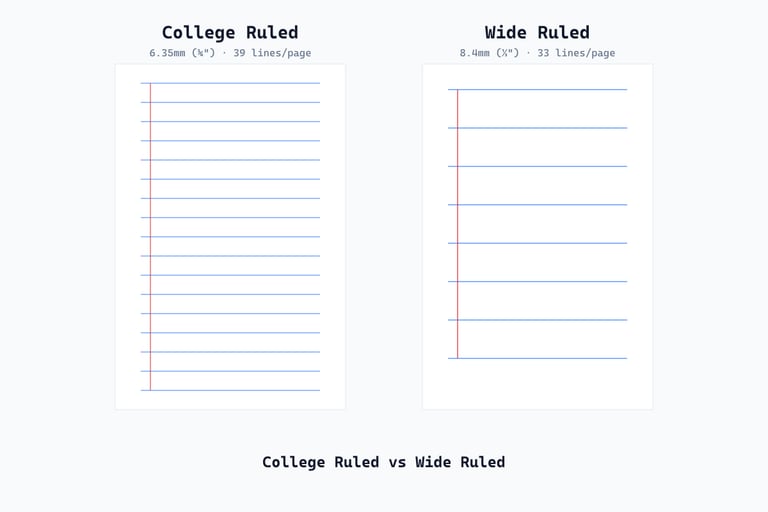
College ruled paper (6.35mm) side-by-side with wide ruled paper (8.4mm) for visual comparison of line spacing

The numbers side by side

FeatureWide ruledCollege ruled
Line spacing8.4mm (⅓")6.35mm (¼")
Lines per Letter page~33~39
Standard userElementary school, kidsHigh school, college, adults
Best forLearning to write, large handwritingDense notes, efficient writing

What are college ruled notebooks?

A college ruled notebook is any notebook (spiral, composition, or binder-style) with horizontal lines spaced at6.35mm (¼"). These notebooks typically have a red margin line about 32mm from the left edge and hold roughly 39 lines per Letter-size page. They're the default for most US high school and college supply lists because they balance writing density with legibility — more content per page than wide ruled, without the cramped feel of narrow ruled.

What is a wide ruled notebook?

A wide ruled notebook uses 8.4mm (⅓") line spacing, giving about 33 lines per pageon standard Letter paper. The wider spacing makes these notebooks the standard choice for elementary school students (kindergarten through roughly 5th grade) who are still developing handwriting skills. Adult writers with larger handwriting or vision needs also prefer wide ruled for comfort.

How many lines on wide ruled paper?

Wide ruled paper gives you approximately 33 lines per page on standard US Letter (8.5 × 11"). That's about 6 fewer lines than college ruled (~39 lines) and roughly 15 fewer than narrow ruled (~48 lines). The trade-off is more generous vertical space per line — 8.4mm instead of 6.35mm — which makes it easier to write larger letters without crowding.

Narrow ruled vs college ruled vs wide ruled

Narrow ruled paper (also called "fine ruled") has the tightest spacing at roughly 5mm per line, yielding about 48 lines per page on Letter paper. Here's how the three compare:

RulingSpacingLines/pageBest for
Narrow ruled~5mm~48Dense notes, international schools, small handwriting
College ruled6.35mm (¼")~39High school, college, general adult use
Wide ruled8.4mm (⅓")~33Elementary school, large handwriting, vision needs

Narrow ruled vs college ruled: the 1.35mm difference gives you about 9 extra lines per page, but can feel tight if you don't write small. Narrow ruled is more common in the UK, Europe, and parts of Asia, while college ruled dominates the US.

What size is college ruled paper?

"College ruled" refers to the line spacing (6.35mm or ¼"), not the paper dimensions. You can buy college ruled paper in multiple sizes — US Letter (8.5 × 11") is the most common, but A4 (210 × 297mm), A5, and Legal (8.5 × 14") are also widely available. When using our generator, you can set any paper size and apply college ruling on top of it.

Do 5th graders use wide or college ruled paper?

Most US elementary schools use wide ruled paper through 5th grade. By middle school (6th grade), teachers typically switch to college ruled. That said, this varies by school district — some transition earlier in 4th or 5th grade if students show controlled handwriting, while others wait until 6th. If your 5th grader writes neatly with small, consistent letters, college ruled can work; if they're still developing letter sizing, stick with wide ruled.

College ruled notebook vs regular notebook

A "regular" notebook usually means either wide ruled or blank/unruled depending on context. Compared to a blank notebook, college ruled gives you structured horizontal lines for straight writing — important for notes and essays. Compared to a wide ruled notebook, college ruled fits about 18% more text per page (39 lines vs 33). If you're buying a general-purpose notebook and aren't sure, college ruled is the safer default for anyone past elementary school.

Wide ruled: the spacious choice

Wide ruled gives you more vertical room per line. Letters can be taller, loops can be wider, and there's less risk of cramming or overlapping with the line above. This is exactly why it's the standard in American elementary schools — kids are still developing fine motor control and need extra space to form letters properly.

Wide ruled is also a better fit for:

  • Children learning cursive (3rd grade and up)
  • Adults with large or loose handwriting
  • People with visual impairment who benefit from extra spacing
  • Occupational therapy sessions
  • Anyone who just finds it more comfortable

College ruled: the efficient choice

College ruled trades a little vertical space for roughly 18% more lines per page. For older students and adults who write a lot, that extra density is valuable — you can fit an entire lecture's worth of notes on two pages instead of three, and your notebooks stay thinner.

College ruled is the right pick for:

  • High school and college note-taking
  • Meeting minutes and professional note-taking
  • Journaling when you want more content per page
  • Anyone with smaller, controlled handwriting

So which should you choose?

Use this quick rule: if you're under 10, learning to write, or have large handwriting — go wide ruled.Everyone else is usually better served by college ruled.

There's no rule against choosing what feels most comfortable, though. Many adults who write large prefer wide ruled, and many teens write so small that they'd be happy with even narrower spacing. The beauty of printable paper is you can try both in 30 seconds and pick what feels right.

Try both for free

Our free lined paper generator includes both wide ruled and college ruled presets. Generate each, print a sample page, and decide. If neither feels right, use the custom spacing slider to set any line distance from 4mm to 30mm.

Ready to make your own paper?

Skip the templates — generate exactly the paper you need, free.

Open the Generator