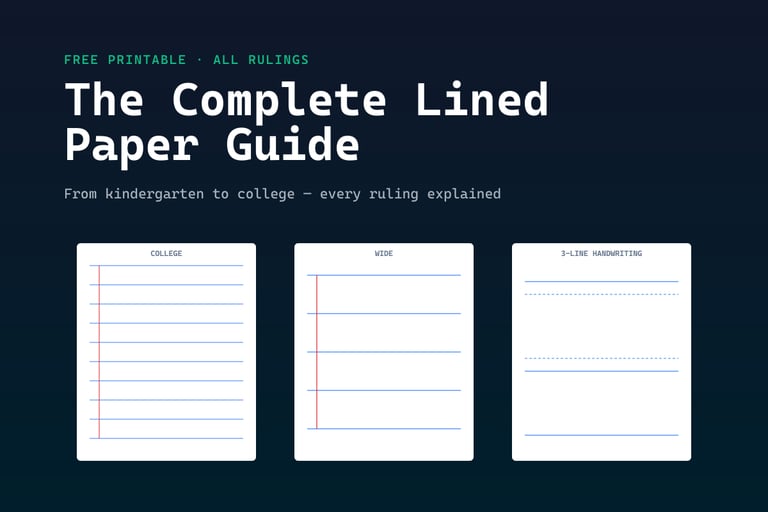
"Lined paper" sounds like one thing, but there are at least a dozen different rulings used around the world — each designed for a specific age, handwriting style, or use case. This guide walks through every ruling you'll commonly encounter, what it's for, and how to pick the right one.
A brief history
Lined paper dates back to at least the medieval period, when scribes used ruled lead sheets under parchment to keep their writing straight. Mass-produced ruled paper became common in the 19th century as education spread and writing became a universal skill. Different countries developed their own standards — which is why you'll see French "Séyès" paper with 8mm grid squares, German "Lineatur" paper for elementary school, and the American college/wide ruling system.
The American standard: 4 common rulings
Narrow ruled (~5mm / 0.20")
The tightest standard ruling. Each line is only 5mm tall. Used in some international primary schools and for applications where you need to fit as much text as possible — meeting notes, dictation, data entry. Handwriting must be small and controlled.
College ruled (6.35mm / ¼")
The workhorse ruling for US high school and college students. Fits roughly 39 lines per Letter-sized page. The standard in academic notebooks (the iconic black-and-white composition notebook).
Wide ruled (8.4mm / ⅓")
The American elementary school standard. Extra vertical space accommodates developing handwriting skills and larger letters. Most Kindergartners through 4th graders use wide ruled.
Gregg ruled (9.5mm / ⅜")
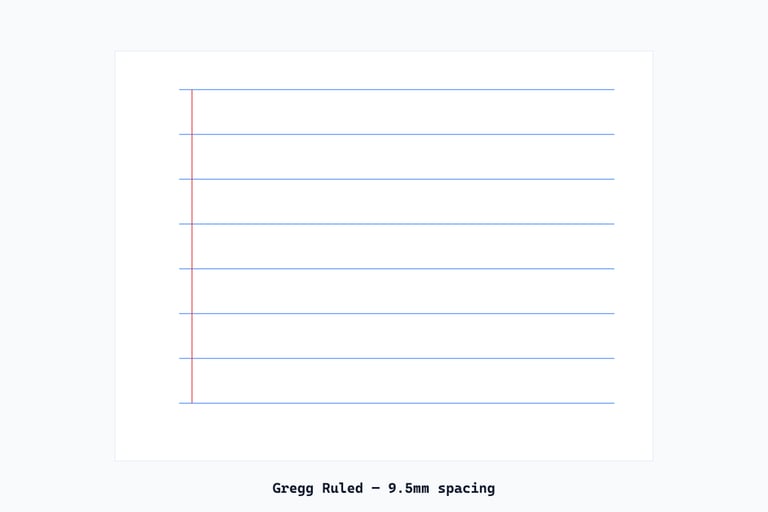
The standard for Gregg shorthand, a phonetic writing system used for dictation and stenography. The wider spacing gives the curved shorthand symbols room to breathe. Also used in some occupational therapy settings.
3-line handwriting paper (Dotted Third / SLT)
A completely different design: instead of evenly-spaced horizontal lines, you get three lines that define letter height. The top and bottom lines are solid, and the middle line is often dashed.
- The space between the middle and bottom lines is for lowercase letters (x-height)
- The space between the top and middle lines is for ascenders (b, d, h, k, l, t)
- The space below the bottom line is for descenders (g, j, p, q, y)
This format is the standard in early elementary classrooms across the US, UK, Canada, and Australia. It's also widely used in occupational therapy to help children form letters correctly.
International standards
Séyès (France, French-speaking countries)
French students use a paper covered in a grid of 8mm × 8mm squares, with light horizontal lines every 2mm inside each square. The grid is used for both math and writing — the squares keep math aligned, and the horizontal lines guide letter height. Distinctive pale purple/blue color.
Lineatur (Germany, parts of Europe)
German elementary school paper has three or four lines that define letter height similarly to the US dotted-third system. Different grades use slightly different line configurations (Lineatur 1, 2, 3, 4...) as students progress.
Metric narrow ruled (UK, Australia)
UK and Australian exercise books typically use narrow metric ruling (around 7-8mm), with no vertical margin line. "A4 exercise book" is a specific stationery item in the UK.
Specialty paper types
Cornell notes
Designed for the Cornell note-taking system. The page is divided into a narrow cue column on the left, a wide notes column on the right, and a summary strip at the bottom. See our Cornell notes template.
Graph paper
A continuous grid of squares. Most common is 5mm metric, but 1mm, 2mm, 1/4", and 1/5" grids also exist. Used for math, engineering, and design. See our graph paper generator.
Dot grid
Dots at regular intervals (usually 5mm) instead of full lines. Popular for bullet journaling and design work. See our dot grid generator.
Music staff
Five-line staves evenly spaced down the page. Used for handwritten music notation. See our music staff generator.
How to choose
Quick cheat sheet:
- Kindergarten to 2nd grade: 3-line handwriting paper or wide ruled
- 3rd to 5th grade: Wide ruled transitioning to college ruled by 5th grade
- Middle school to college: College ruled
- Note-taking & study: Cornell notes template
- Math & engineering: Graph paper
- Bullet journaling: Dot grid
- Music: Staff paper
Of course, you can use whatever paper feels right. The "right" paper is the one you'll actually use — and ourfree generator lets you try every ruling in 10 seconds flat.